This HUB is your central resource for program updates, key initiatives, tools, documentation, and team collaboration. It is designed to keep you informed, connected, and empowered with the information you need to run a student workshop. Everything you need to prepare, teach, encourage, and grow as a facilitator is right here. Whether you’re leading your first workshop or your hundredth, we’re here to support you every step of the way.



This section gives you access to the No Apologies® course content — the same lessons and materials your students will see, unit by unit. Use it to review what’s covered before you teach, refresh your memory between sessions, or follow along in real time as you lead a workshop. Everything is organized in the order students will experience it.
Your progress through the course is tracked separately from your students’. This gives you a way to stay one step ahead — previewing upcoming material, checking discussion prompts, or reviewing a topic you haven’t covered in a while.
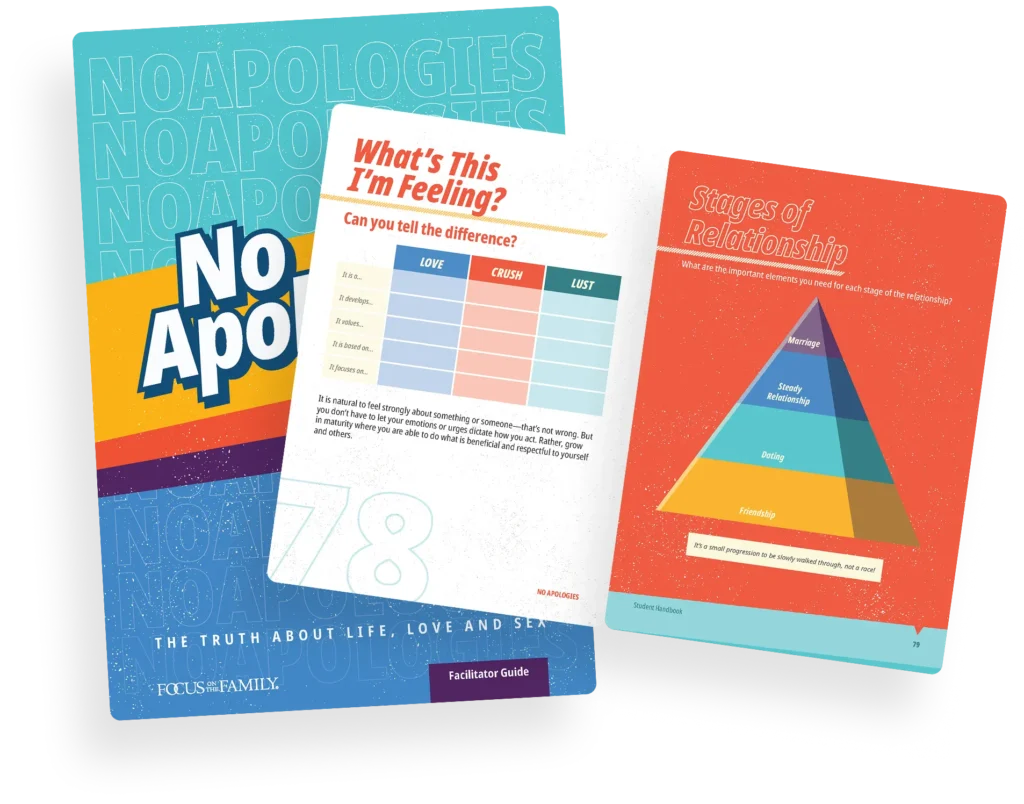
The Facilitator Guide is a reference document covering everything you need to prepare for and lead a No Apologies® workshop. It includes an introduction to the program, an overview of character-based sexuality education as the foundation of the curriculum, guidelines for facilitators to follow when leading a session, and a full breakdown of the curriculum itself.
Use it to get oriented before your first workshop, or come back to a specific section — guidelines, curriculum structure, or program background — whenever you need a refresher.


Download the student pledge card, or fill out the form to request the curriculum in printed copy if you’d rather teach with a physical book in hand.
Learn from experienced trainers, counselors, and subject-matter experts as they answer common questions and provide practical guidance for leading effective workshops. Each video is designed to equip you with practical tools and fresh insights to help you engage students with confidence
This section covers selected frequently asked questions by participants of No Apologies workshops. The answers provided are by no means exhaustive. Please refer to the list of recommended resources for a more in-depth study of the issues highlighted.
The truth is, making the decision to be abstinent once is not enough. You have to keep on making that decision regularly, in big and small ways. At times when you’re tempted, it may not be easy and it takes character, determination, and self-control to stick to your decision.
To help you stick to your choice to be abstinent, you should tell someone about your decision so that he/ she can keep you accountable — someone who will remind you to stick to your choice. This person should be someone older and trustworthy such as a parent, teacher, leader, or counselor. Of course, this means that you have to tell this person what’s going on in your life, especially when it comes to the opposite sex. The benefits are tremendous and you’ll also feel encouraged, knowing that you’re not alone in this.
If you are already in a relationship, don’t get into situations where you would be tempted to go beyond the “point of no return.” This refers to the beginning of sexual arousal when it’s difficult to stop physically leading very quickly to sex. Avoid foreplay that pushes you in the direction of sexual temptation. Decide TODAY that you will not be alone with your partner, such as when family members aren’t around or with her/him in a room with the door shut.
Finally, be careful of what you feed your mind. Stay clear of materials that will cause you to lust after the opposite sex. Today, sexually stimulating images are so rampant in the media (magazines, Internet, movies) that it’s so easy to get used to them, not knowing how they can destroy our capacity to appreciate real relationships.
I hope this helps you in your decision to be abstinent until marriage, and you’ll be more determined to wait for all the way till your wedding day.
One of the primary reasons chastity is unpopular is because the media and popular culture promote the false idea that unrestrained sexual expression is the ultimate sign of “freedom.” In reality, however, sexual activity outside the bounds of marriage between a man and a woman brings oppression in the form of guilt, shame, and the potential for unwed pregnancy or sexually transmitted infection. Beyond this, society fails to support and encourage those who aim to lead chaste lives, instead encouraging the opposite — a culture where nearly anything goes sexually.
The reality is that for those who are unmarried, chastity brings true freedom – from the emotional consequences of premarital sex, from sexually transmitted infections, and from pregnancy. Chastity affords you the opportunity to pursue life goals, to be pursued for who you are as a person and not just for sex, to experience real intimacy with your future spouse, to respect yourself and others, and to live your life to its fullest potential without unnecessary trouble.
Stated succinctly, the opposite is true: abstinence-based programs (Sexual Risk Avoidance, SRA) are shown to be effective, while comprehensive sexual education (Sexual Risk Reduction, SRR) programs do not report significant outcomes with regard to teenage/young adult sexual activity.
Of more than a dozen studies,45 have found that abstinence education programs have produced superior outcomes when compared to CSE (SRR) programs. Studies suggesting that CSE (SRR) programs are effective rely on incomplete, biased data.
Of course, abstinence education does not need to happen in isolation. It works best when reinforced by a student’s family and faith communities.
Yes, you are right. Sex and marriage go together. This is because sex is an intense physical experience that creates bonds between a man and a woman. These bonds are not just body to body, they are emotional and spiritual too! Sex is a gift that has the power to connect people for life – forever.
But just as sex can connect two people for life, it can also destroy people – for life. Without the lifelong commitment of marriage, this can become a nightmare on many different levels. On the physical level, it can lead to an unplanned pregnancy and sexually transmitted infections. On the emotional level, it can cause feelings of being used, insecurity, loneliness, bitterness, and jealousy.
When a man and woman get married, they are making a commitment to be faithful, to love unconditionally, and to remain faithful until death. This commitment forms the safe and protective boundaries for a man and a woman to give themselves totally to each other (physically, emotionally, and spiritually).
Nobody really knows if they will get married in the future or not. But today, you have the opportunity to make a decision to save sex for the person you will one day marry. Don’t be deceived into thinking that you are missing out if you don’t have sex now, or that you may never get married, so you might as well have sex now. Don’t give in to the temptation to trade the best for something that’s fake. I assure you, you will find that every minute you wait will be totally worth it!
First, we applaud the conviction and understanding that comes with your choice to abstain from sex before marriage. This is a choice that you and your future spouse won’t regret making and an investment that significantly increases your chances of having a healthy marriage later on.
However, we strongly advise against spending the night in the same bed with your girlfriend even without the intention to have sex. The reason why is simple: temptation. Being next to each other in a private setting without others around to hold you both accountable is a recipe for errors in judgment. Sexual purity before marriage is difficult to achieve even without sleepovers, even for those with the strongest of resolve.
Sleepovers set the dominos falling toward cohabitation. If you and your girlfriend believe your relationship may eventually lead to marriage, then it’s worth keeping in mind that cohabitation corresponds to a 50 to 80% higher chance of divorce. Living and sleeping separately before marriage offers the best prospect of marital success.
If you presently spend the night with your girlfriend, then we encourage you to find a way of talking with her about how your living arrangement can be improved. Though it may be an awkward transition, it’s the right thing to do and it will increase your chances of having a healthy marriage later on.
If it’s just getting to know the person because you find her interesting, then you don’t have to check if she has a disease. After all, your focus should be getting to know her as a person, her likes and dislikes, her character, dreams, and goals. This shouldn’t involve any physical intimacy. A friendship must always be built on trust and honesty. You might eventually talk about health issues, but it shouldn’t be a prerequisite to friendship.
Even if you are thinking of asking her to be your girlfriend and dating her (hanging out exclusively), your relationship shouldn’t be physical. It’s very important that both of you are committed to sexual abstinence – no petting and definitely no sex! Focus on developing the friendship further and treating her like a lady, with respect and honor.
When you are in a committed relationship and considering marriage, that’s when it’s more appropriate to share about your past relationships and any health concerns.
If used mindfully and for the right purpose (i.e., pursuing a healthy long-term relationship that could potentially lead to marriage rather than merely “hooking up”), then dating apps, websites, and services can be helpful tools. Many couples who are happily and stably married today met via online dating.
Bear in mind that many, if not most, users of dating apps might not share your values. It’s also important to note that the apps and services themselves vary wildly. If you decide to engage in online dating services, look for those that are geared toward forming healthy long-term relationships through personality profiles, compatibility tests, faith and values assessments, and other tools. Avoid apps that are only designed to facilitate one-night stands and hookups.
We are so sorry to hear about the pain you experienced growing up in a broken home. If your situation was marked by significant dysfunction or the absence of strong parental role models, it’s understandable that you would feel discouraged about moving beyond that cycle of brokenness in your own future marriage and family.
At the same time, we want to encourage you with the thought that there is hope! History is full of men and women who endured incredibly difficult childhoods, and yet they were able to establish healthy relationships and stable families as adults. In fact, many people have testified that growing up in a difficult home actually helped them later in life because it made them aware of certain behaviors and patterns of dysfunction that should be avoided.
Now is the time to invest in the health and stability of your future spouse and children. The fact that you’ve participated in the No Apologies program demonstrates your desire to become an emotionally and relationally healthy spouse and parent in the future.
Even if your current home situation remains difficult, we encourage you to find other sources of encouragement and inspiration. There are numerous books, courses, and programs that might be helpful in equipping you for marriage and family life. If you’re a member of a faith tradition, your spiritual leaders and congregation can also be sources of encouragement and support.
Finally, remember that your future married life does not have to be perfect. Challenges will appear in your relationships with your spouse and children even under the most ideal of circumstances. But with faith, determination, and the support of friends, extended family, and a faith community, there is every reason to believe you have a bright future ahead when it comes to marriage and family!
As a general rule of thumb, when in the presence of people you don’t like, it’s important to remain polite, keep your conversations brief, and refrain from public displays of hostility!
But when one starts acting in a way that gives the false impression that they are a person’s friend, though they’re actually gossiping about them behind their back, they start losing something very precious to healthy relationships – authenticity. If I were you, I’d stay away from such people – girls or guys!
You’ll find it hard to trust them or be real with them, and you’ll soon find that the friendship is only superficial.
So why do some girls do it? Girls tend to be more aware – and vocal – about their feelings, especially if it’s about something they don’t like. Yet, they may not feel it is appropriate to confront the person. Not that these actions should be justified, but understanding why they act that way does help us extend grace toward them.
My encouragement to you is this: if you have friends who are authentic and honest, treasure them and likewise be genuine toward them. Truth be told, genuine and loyal friends are not that easy to come by. It takes continued effort and humility. But you’ll find it all worthwhile when you get older, as these are the friends you’ll want to face life and all its storms with.
Some religious and cultural traditions advise against the use of contraception. We believe that all human life has value and that life begins with fertilization (the union of sperm and egg). For this reason, we don’t believe that it’s wrong to prevent fertilization using certain forms of contraception, but we oppose any method of so-called birth control that functions as an abortifacient (acting after fertilization to end a human life by preventing implantation in the womb).
For those who are married and who have questions or concerns about contraception, we advise consultation with a trusted counselor or spiritual leader.
In most cases, there is no reason that mutual masturbation should be considered off-limits for married couples, provided that both partners are amenable to it.
We believe this activity, along with some other forms of sexual expression beyond actual intercourse, can be left to the judgment of the couple.
HOWEVER, it is important that:
1. Both husband and wife consent to the activity.
2. Neither spouse has had an issue with sexual brokenness (masturbation, pornography, etc.) that may be complicated by this choice.
For further input on sexual expression in marriage, we encourage couples to seek the advice of a trusted marriage counselor or spiritual advisor.
Just so that we are on the same page — masturbation refers to the act of stimulating one’s own sexual organs for the purpose of achieving sexual pleasure.
Let’s start with some facts,
– Fact: 98% of men and 44% of women have masturbated.44
– Fact: In spite of numerous terrifying myths that you’ll become mentally handicapped, impotent, or go blind, there is no scientific evidence to show that masturbation is harmful to your body.
However there are some very real concerns about the emotional effects that masturbation can have on a person, and the truth is, most people experience one of these effects that not only harm themselves but people around them as well.
Know first that you are loved and valued, and even in the midst of despair, there is hope. Your life has a purpose even if it doesn’t feel like it right now.
Feelings of depression and hopelessness can be beaten, as can suicidal thoughts. You are stronger than the pain you feel. Depression and suicidality are physiological conditions for which there is helpful treatment.
Whatever you do, don’t make the mistake of trying to face this challenge alone. Reach out to friends, family, neighbors, and other trusted members of the community. Build a support network. Lean on them and be open about what you are feeling. It can be difficult for those around you to notice the warning signs, so being direct is important.
If you’re currently having suicidal thoughts, here are four important steps to take right now:
– Connect with another person as soon as possible. Isolation and hiding are the greatest risks to address if you are having thoughts of suicide.
– Call the 24-Hour Suicide Hotline. The number is 1-800-273-TALK. Someone is always there to answer the phone, and they even provide online chat. (Please include your local suicide hotline, https://en.wikipedia.org/wiki/List_of_suicide_crisis_lines)
– Call 911. If you find yourself in a dangerous situation and you want to harm yourself, or you know someone who wants to self-harm, don’t hesitate to call 911. (Please include your local emergency number)
– Contact a trained counselor. For ongoing care, we encourage you to connect with a reputable counselor who can help you navigate this difficult season.
Take heart. There is hope and a future for you!
If the participants have questions on topics which are not covered in . (such as LGBTQ or drug addiction), do encourage them to speak with their parents or seek professional advice from school counselors and doctors. They can contact the local Focus on the Family office for help or referrals.
Sexting is defined as sending explicit text messages, photos, or images over mobile phones or social media. This behavior is a growing trend among teenagers. Most teens see sexting as nothing more than high-tech flirting. The reason “It’s just innocent fun. I’m not hurting anyone.”
That simply isn’t true. Many young people seem to take the credit card approach to sexting that they do to other sexual activity: play now, pay later. If you are sending or receiving nude images, you will pay a price, and you will get hurt.
One of the primary consequences of sexting is public humiliation. Studies indicate that a majority of guys who receive sexting will share it with others. You may send an image with the intention that only your boyfriend will see it, but it’s not likely to remain for his eyes only. And when the images get out, they are out there forever, and the consequences can be devastating. Your future employer could see them. Your parents could see them. Your future spouse or children could see them. And somebody will definitely get hurt.
Adapted from McDowell, J. (2011) The Bare Facts (pp 88-89).
We are so sorry to hear about any ongoing bullying or harassment that you are facing. No matter the age or background, bullying is an affront to human dignity and can have severe consequences on the victims’ physical and emotional health. Stalking and other forms of harassment — including online — can cause untold measures of pain.
If you are personally affected by bullying, bring in your support system! Whether that includes parents, friends, faith leaders, or trusted teachers, it can be helpful to be reminded that others care about you and want to stop the harassment. If necessary, law enforcement can be a useful ally for addressing serious instances of bullying, as well as any form of harassment and stalking.
If you see signs of bullying in your siblings or friends, don’t hesitate to ask them about it. However, be sensitive. One way to bring up a difficult topic is to de-personalize it. For example, you might mention that “some people” have encountered bullying. You can talk about the problem as a universal issue.
Then, when you’re both feeling more comfortable, shift the conversation and talk about their personal experience.
Bullying can have a very real, negative impact on the victim. Don’t hesitate to reach out to a qualified counselor if you feel it might be helpful for you or someone you care about.
Sadly, illicit sexual material is so prevalent in our world that the prospect of avoiding it seems daunting. However, there are some practical steps you can take to adopt a positive mindset in this arena.
The first is to form healthy relationships with members of the same sex who can help hold you accountable and who you can encourage in the pursuit of purity. A good place to start would be same-gender friends who have participated in the No Apologies program with you. There is strength in numbers, and the knowledge that there are like-minded friends with you on this journey can make a big difference.
You can also investigate filtering software for your computer at home or an app for your phone. These programs aren’t perfect, but they can help you screen out pornography and other illicit content. And again, if you have like-minded friends who are using the same program, most apps have an accountability feature that will enable you to encourage one another in pursuing sexual purity.
Even if you fall short at times — as we all do — rest assured that it is worth the effort to recommit yourself to pursuing sexual purity and taking whatever steps are necessary to achieve it. Whether you are single or married, if you are experiencing ongoing and repeated defeat in this arena, such as with an addiction to pornography, we urge you to work with a qualified counselor or religious advisor to help address the issue.
If you want to prepare for a healthy, enriching sex life when you’re married, pornography is the very last place you want to look. Here are some basic facts about porn, based on solid research.
Dr. Mary Anne Layden, a psychotherapist and Director of Education at the Center for Cognitive Therapy at the University of Pennsylvania said:
“The messages of Internet pornography are psychologically toxic, untrue, difficult to undo and are shaped by individuals whose goals are to make money without concern for the consequences.”
We owe it to our youth to give them the best, protect them from the worst, and use our wisdom, education, and experience to decide which is which.”
We do not condone any sex education curriculum that encourages the use of pornography or masturbation as means of addressing sexual urges.
Instead, abstinence education, which produces superior results when compared to “comprehensive sexual education,” should be the method by which students are instructed about sexuality in schools. This should be supplemented with age-appropriate instruction in the home.
Yes, consuming pornography is always wrong, both inside and outside the bonds of marriage. It destroys the mystery and meaning of sex, it creates false expectations and it fosters emotional and physiological damage in both men and women. The pornography industry is tied to human trafficking and by its very nature exploits women. Those who consume porn, even if it is “free,” are indirectly supporting this wicked industry. By proposing to bring porn into your bedroom, you’re basically telling your spouse that you want to have multiple sex partners at the same time. There are positive ways to spice up your sex life in marriage, but pornography isn’t one of them.
The Merriam-Webster Dictionary defines lust as “intense or unbridled sexual desire; lasciviousness.” This definition alone, which speaks of consuming, self-centered emotion, should serve as a warning against lust. It is unhealthy and destructive to human relationships.
Be mindful that sexual attraction is different than lust. Sexual attraction that is part of our humanity is normal. Feeling attraction toward one’s partner is natural and should be carefully stewarded. To let sexual attraction exceed that, in a way that dominates your thoughts or life, is to succumb to lust.
Even in marriage, where sexual activity is appropriate, lust has no place. The sexual relationship in marriage is about self-giving, self-sacrifice, and mutual enjoyment. These qualities are antithetical to lust.
Being tempted by lust is very common; restraining oneself from these drives is a virtue. Though love may abound in premarital relationships, and the excitement of dating and engagement intensifies with time, resisting lust will only strengthen the emotional connection in the long run.
It’s great that you have set for yourself a guideline for when you will consider entering into a relationship. And I’m glad that you are concerned about how to reject a guy/girl as opposed to giving him/her false hope! It shows maturity and a commitment to your goals.
Having feelings for the opposite sex is natural and nothing to be afraid of. When these feelings arise, you can acknowledge them, but you don’t have to act on them and jump into a relationship. Look at it this way. Focusing on your goals now may also get you closer to meeting someone who’s headed in the same direction further down in life! Having said this, here are some suggestions on how you can approach friendship with the opposite sex right now.
First of all, I want you to understand that you’re definitely not alone. Being confused about sexual identity is actually quite common among teens.
Rest assured that some of the conflicting feelings and emotions you’re experiencing, as well as the questions you may be asking yourself — “Who am I?”, “What does it mean to be a man or woman?” and “How do I feel about the opposite sex?” — are often a normal part of growing up. At your age, sexual desires, as well as the longing for affirmation, approval, and friendship, can range far and wide.
Know what else is really common? Finding a person of the same sex attractive, admirable, appealing, or interesting. Young people and adults alike do this. You may like someone’s personality, the way he/she looks or his/her abilities. Again, just because you think someone of the same sex is admirable or you enjoy hanging out with them, that doesn’t mean you’re gay! Don’t label yourself as gay or bisexual.
Be extra cautious of members of the same sex who seem to enjoy your admiration and who encourage you to act upon same-sex desires. They could be dealing with sexual-identity confusion, and it would be wise for you to reduce interactions with them.
Understand that struggling with same-sex attraction or experiencing same-sex temptations isn’t wrong, but acting upon these desires is not the right thing to do. “Gay” does not describe who a person is. Instead, it’s a political term that describes a chosen identity, preference, and lifestyle. Despite what you may have heard, men and women simply are not born homosexual.
After ten years of taking a pro-nature stand on the nature-nurture debate on homosexuality, the 2008 American Psychological Association (APA) brochure acknowledges that the evidence collected does not support the conclusion that homosexuality is caused by one’s genes. Instead, it is just one of the many other interacting factors that can result in homosexuality.46 The recent study done by an international team of researchers, co-led by Benjamin Neale of the Broad Institute of Harvard and MIT also concluded: there is no one gene for being gay, and though genes seem to play a role in determining sexual orientation and same-sex behavior, it’s small, complex, and anything but deterministic.47
Getting help is another important step you’ve got to take. Don’t struggle alone. We can refer you to counselors who would be more than willing to be a listening ear and work through your feelings with you.
This is a complex topic, but the short answer is, no. It is not wrong to experience same-sex attraction. However, to act on those feelings and pursue sexual relationships with members of the same sex is
Experiencing feelings of same-sex attraction can be a source of great tension and pain; however, guilt is not the answer. Feeling temptation toward the same sex is not inherently wrong or sinful, as we are all tempted daily. Resisting temptation is a virtue, and those who experience same-sex attraction can do so by not engaging in same-sex relationships and by practicing celibacy as they seek guidance.
We encourage you to place a high priority on preserving and maintaining positive relationships with the LGBT people in your life. To do this, you need to find consistent ways of expressing and demonstrating your love for them. But you must realize that love and approval are not always the same thing.
Although the pressure to celebrate same-sex relationships can seem overwhelming, it’s important to remember that this is a very recent development. Historically the strongest and most stable societies are those that have not embraced same-sex relationships or the idea that gender and sex are fluid.
You can support the material and emotional needs of your LGBT friends and family without condoning concepts like same-sex marriage and gender transition. Care should be exercised when approaching these topics; lead with love in these conversations, respecting that a difference of opinion may exist. We know this is a complicated and personal subject. Here again, we would encourage you to seek additional guidance from a parent, counselor, or religious leader.
There is a broad range of issues that may lead someone to experience same-sex attraction. As one author has noted, “Homosexuality probably results from a combination of factors… personality, relationships, trauma, developmental issues, and cultural influences.” So, there is merit to the claim that one may not have “chosen” to be part of the LGBT community.
Nonetheless, the same-sex attraction seems to be environmentally influenced beyond any genetic predisposition, as studies do not show that all identical twins experience same-sex attraction if their twin does.48
Whether it is a friend or family member who expresses same-sex attraction, we ask you to consult well-informed sources as you support and counsel them. They may genuinely feel that this is not a lifestyle they have chosen. Encourage them with the thought that even if their attractions were not chosen, there is a capacity for change.
The answer is, yes! You will not die if you do not have sex. If that was so, most teenagers would be dead; and so would a great many adults.
A lot of messages out there tell us that everyone is having sex, and if you don’t have sex, you’re not cool and missing out. But that’s not true! A person’s value is not based on how much sex they’ve had.
The media may portray that sex is essential and something that everybody does. Again, this is not true. We are humans — humans with self-control and the ability to make decisions. If we choose not to have sex, we can stick with that decision. And by that, we can be proud that we stood up for what we believed in instead of following what some other people say.
No. It is not sinful to have sex with your spouse when procreation isn’t the goal.
Procreation is only one of several gifts that sex provides. It is also pleasurable, and it bonds husbands and wives physiologically, emotionally, and spiritually even when pregnancy is not the goal or the result.
The desire for romantic companionship during a season of singleness is understandable. Romantic relationships and marriage seem to promise the fulfillment of many profound desires: the need to be considered special by another person, the desire for companionship, and, when it comes to marriage, the prospect of sexual intimacy and eventually having children. Your feelings are completely natural.
However, we encourage you to recognize that being single presents both challenges and opportunities. Don’t make the mistake of believing that romantic relationships or marriage are the solutions for unhappiness or feelings of unfulfillment. Actually, romantic relationships can often complicate the task of personal growth, and the emotional frustrations brought into marriage sometimes only increase in their intensity. There are many needs in our lives that a boyfriend, girlfriend, or spouse can never meet. Although singleness is not your choice at this time, we are convinced that you can use it to your advantage by focusing on your own personal growth, by investing in healthy friendships, and by making every effort to become the right person rather than find the right person.
In our sex-saturated world, it can be incredibly difficult for single people to practice abstinence. We empathize with your situation, but we urge you to exercise great self-control during this crucial time in your life. Nothing positive can come from compromising in this important area. Sexual promiscuity will jeopardize your personal and spiritual growth and could undermine your marital relationship should you feel called to that in the future.
Promiscuity and pornography will only hamper your emotional and spiritual resilience. Instead of “meeting” your needs, these outlets will only worsen your sexual brokenness over time. Stewarding your sexuality and choosing chastity can be difficult, but it’s worth it.
I’m really glad that you want to be abstinent until marriage! It’s the best decision you can make for your future. Let me also encourage you by saying this: mistakes are not final.
It may not be easy at first, but you can make these smaller decisions that will help you keep your commitment:
– Avoid being alone with someone of the opposite sex, especially in a bedroom or any quiet and deserted place. Being around friends and family will help keep sexual temptation at bay. Also, stay clear of alcohol because it can very easily cloud your judgment.
– Tell someone about your decision so that he/she can keep you accountable and remind you to stick to your choice. This person should be someone older and trustworthy such as a parent, teacher, leader, or counselor. Of course, this means that you have to tell this person what’s going on in your life, especially when it comes to the opposite sex. But the benefits are tremendous and you’ll also feel encouraged, knowing that you’re not alone in this!
– Be careful of what you feed your mind. Stay clear of material that will cause you to lust after the opposite sex. Sexually stimulating images are so rampant in the media (magazines, Internet, movies) that it’s so easy to get used to them, not knowing how they can destroy our capacity to appreciate real relationships.
– Conduct a health check – it’s important to confirm that you are not infected with any STIs. Left unchecked, they may cause long-term health problems including infertility.
– If you’re in a dating relationship, make a commitment together with your partner to abstain. If your partner does not believe in abstinence, it will be very hard for you to stick to your commitment. This person may not be the best one for you if he does not respect your choice to remain abstinent from sexual activity until marriage.
– Set clear boundaries with your partner. Both of you may have agreed to abstain from sexual activity, but how about kissing and “making out?” It’s best to limit it to a quick, short goodnight kiss in a safe place – or just a quick hug. It is wise to communicate these expectations at the start of your new relationship so that a moment of passion does not lead to a lifetime of regret.
– Focus on developing healthy and deep friendships instead of fixating on romance and intimacy. Meaningful friendships make life much more fulfilling, so invest your time and energy in them! Pick up a new hobby together and talk about the important things in life – like your dreams and goals and help each other achieve them.
It takes real character and determination to stick to a commitment. But on your wedding day, when you look back, it will be totally worth it!
As humans, we sometimes fall into temptation and make unwise choices and mistakes – mistakes that could hurt ourselves and others. Having sex before marriage is a mistake that hurts all our future relationships.
If you feel uncomfortable that he/she has had sex before with other partner(s), you need to communicate your feelings. You would be concerned if he/she has contracted an STI from previous sexual experiences. If he/she doesn’t believe in choosing abstinence or thinks that premarital sex is no big deal, it may be difficult and hurting for you to remain in the relationship.
Although a person may have had sexual relations, it’s not the end – they can still choose abstinence until marriage from now on. If he/she is willing to recommit to abstinence, you have to decide if you are ready to love and accept him/her for who he/she is, let go of their past and build a new and healthy relationship that will lead to a fulfilling marriage.
It is more challenging to develop a relationship based on true love and commitment with someone who has been sexually active, but it is possible. What can really help is for both of you to get some guidance and accountability from a trusted adult.
Check out some links to articles on Identity, Sexuality and all things No Apologies!
The National Institutes of Health funded a multimillion-dollar study where sexually confused children were given puberty blockers and opposite-sex hormones: The experiment showed no improvement in their mental health. Read more
Trans ideology has so many women removing healthy body parts and labels it “healthcare” and promotes it as “very safe.”
I just read the following yesterday:
San Diego State University social psychologist Jean Twenge has been tracking how trans ideology is losing its incredible fast-rising grip on teens, reported here و here. She added to her research conclusions recently, looking specifically at sexual identity and behavior and American highschoolers. Her findings are certainly worth digging into.
She explains, in her headline, “Younger teens are now much less likely to say they are lesbian, gay, or bisexual,” and this is also thankfully reflected in much of their sexual behavior.
Drawing her new conclusions from the U.S. Centers for Disease Control’s 2025 Youth Risk Survey, Twenge says the changes in youth sexual orientation identity “are striking.” Declines are happening most starkly among younger teens, and especially among girls. Read more
Sexting is defined as sending explicit text messages, photos, or images over mobile phones or social media. This behavior is a growing trend among teenagers. Most teens see sexting as nothing more than high-tech flirting. The reason “It’s just innocent fun. I’m not hurting anyone.”
That simply isn’t true. Many young people seem to take the credit card approach to sexting that they do to other sexual activity: play now, pay later. If you are sending or receiving nude images, you will pay a price, and you will get hurt.
One of the primary consequences of sexting is public humiliation. Studies indicate that a majority of guys who receive sexting will share it with others. You may send an image with the intention that only your boyfriend will see it, but it’s not likely to remain for his eyes only. And when the images get out, they are out there forever, and the consequences can be devastating. Your future employer could see them. Your parents could see them. Your future spouse or children could see them. And somebody will definitely get hurt.
Adapted from McDowell, J. (2011) The Bare Facts (pp 88-89).
We are so sorry to hear about any ongoing bullying or harassment that you are facing. No matter the age or background, bullying is an affront to human dignity and can have severe consequences on the victims’ physical and emotional health. Stalking and other forms of harassment — including online — can cause untold measures of pain.
If you are personally affected by bullying, bring in your support system! Whether that includes parents, friends, faith leaders, or trusted teachers, it can be helpful to be reminded that others care about you and want to stop the harassment. If necessary, law enforcement can be a useful ally for addressing serious instances of bullying, as well as any form of harassment and stalking.
If you see signs of bullying in your siblings or friends, don’t hesitate to ask them about it. However, be sensitive. One way to bring up a difficult topic is to de-personalize it. For example, you might mention that “some people” have encountered bullying. You can talk about the problem as a universal issue.
Then, when you’re both feeling more comfortable, shift the conversation and talk about their personal experience.
Bullying can have a very real, negative impact on the victim. Don’t hesitate to reach out to a qualified counselor if you feel it might be helpful for you or someone you care about.
Sadly, illicit sexual material is so prevalent in our world that the prospect of avoiding it seems daunting. However, there are some practical steps you can take to adopt a positive mindset in this arena.
The first is to form healthy relationships with members of the same sex who can help hold you accountable and who you can encourage in the pursuit of purity. A good place to start would be same-gender friends who have participated in the No Apologies program with you. There is strength in numbers, and the knowledge that there are like-minded friends with you on this journey can make a big difference.
You can also investigate filtering software for your computer at home or an app for your phone. These programs aren’t perfect, but they can help you screen out pornography and other illicit content. And again, if you have like-minded friends who are using the same program, most apps have an accountability feature that will enable you to encourage one another in pursuing sexual purity.
Even if you fall short at times — as we all do — rest assured that it is worth the effort to recommit yourself to pursuing sexual purity and taking whatever steps are necessary to achieve it. Whether you are single or married, if you are experiencing ongoing and repeated defeat in this arena, such as with an addiction to pornography, we urge you to work with a qualified counselor or religious advisor to help address the issue.
If you want to prepare for a healthy, enriching sex life when you’re married, pornography is the very last place you want to look. Here are some basic facts about porn, based on solid research.
Dr. Mary Anne Layden, a psychotherapist and Director of Education at the Center for Cognitive Therapy at the University of Pennsylvania said:
“The messages of Internet pornography are psychologically toxic, untrue, difficult to undo and are shaped by individuals whose goals are to make money without concern for the consequences.”
We owe it to our youth to give them the best, protect them from the worst, and use our wisdom, education, and experience to decide which is which.”
We do not condone any sex education curriculum that encourages the use of pornography or masturbation as means of addressing sexual urges.
Instead, abstinence education, which produces superior results when compared to “comprehensive sexual education,” should be the method by which students are instructed about sexuality in schools. This should be supplemented with age-appropriate instruction in the home.
Yes, consuming pornography is always wrong, both inside and outside the bonds of marriage. It destroys the mystery and meaning of sex, it creates false expectations and it fosters emotional and physiological damage in both men and women. The pornography industry is tied to human trafficking and by its very nature exploits women. Those who consume porn, even if it is “free,” are indirectly supporting this wicked industry. By proposing to bring porn into your bedroom, you’re basically telling your spouse that you want to have multiple sex partners at the same time. There are positive ways to spice up your sex life in marriage, but pornography isn’t one of them.
The Merriam-Webster Dictionary defines lust as “intense or unbridled sexual desire; lasciviousness.” This definition alone, which speaks of consuming, self-centered emotion, should serve as a warning against lust. It is unhealthy and destructive to human relationships.
Be mindful that sexual attraction is different than lust. Sexual attraction that is part of our humanity is normal. Feeling attraction toward one’s partner is natural and should be carefully stewarded. To let sexual attraction exceed that, in a way that dominates your thoughts or life, is to succumb to lust.
Even in marriage, where sexual activity is appropriate, lust has no place. The sexual relationship in marriage is about self-giving, self-sacrifice, and mutual enjoyment. These qualities are antithetical to lust.
Being tempted by lust is very common; restraining oneself from these drives is a virtue. Though love may abound in premarital relationships, and the excitement of dating and engagement intensifies with time, resisting lust will only strengthen the emotional connection in the long run.
It’s great that you have set for yourself a guideline for when you will consider entering into a relationship. And I’m glad that you are concerned about how to reject a guy/girl as opposed to giving him/her false hope! It shows maturity and a commitment to your goals.
Having feelings for the opposite sex is natural and nothing to be afraid of. When these feelings arise, you can acknowledge them, but you don’t have to act on them and jump into a relationship. Look at it this way. Focusing on your goals now may also get you closer to meeting someone who’s headed in the same direction further down in life! Having said this, here are some suggestions on how you can approach friendship with the opposite sex right now.
We want to hear from you. Please send us an email and someone from our team will be in contact soon.
Email: help@noapologies.com
 English English English
 繁體中文
 简体中文
 العربية
 Монгол
 Español
 Bahasa Indonesia
 Bahasa Melayu
 Kiswahili
 Français
 Українська
 Português do Brasil English English English 繁體中文
简体中文
العربية
Монгол
Español
Bahasa Indonesia
Bahasa Melayu
Kiswahili
Français
Українська
Português do Brasil


الرجاء الانتظار حتى يتم إعادة توجيهك إلى الصفحة الصحيحة...